Hydration
How much water and salt per hour? Do a 1-hour sweat test.
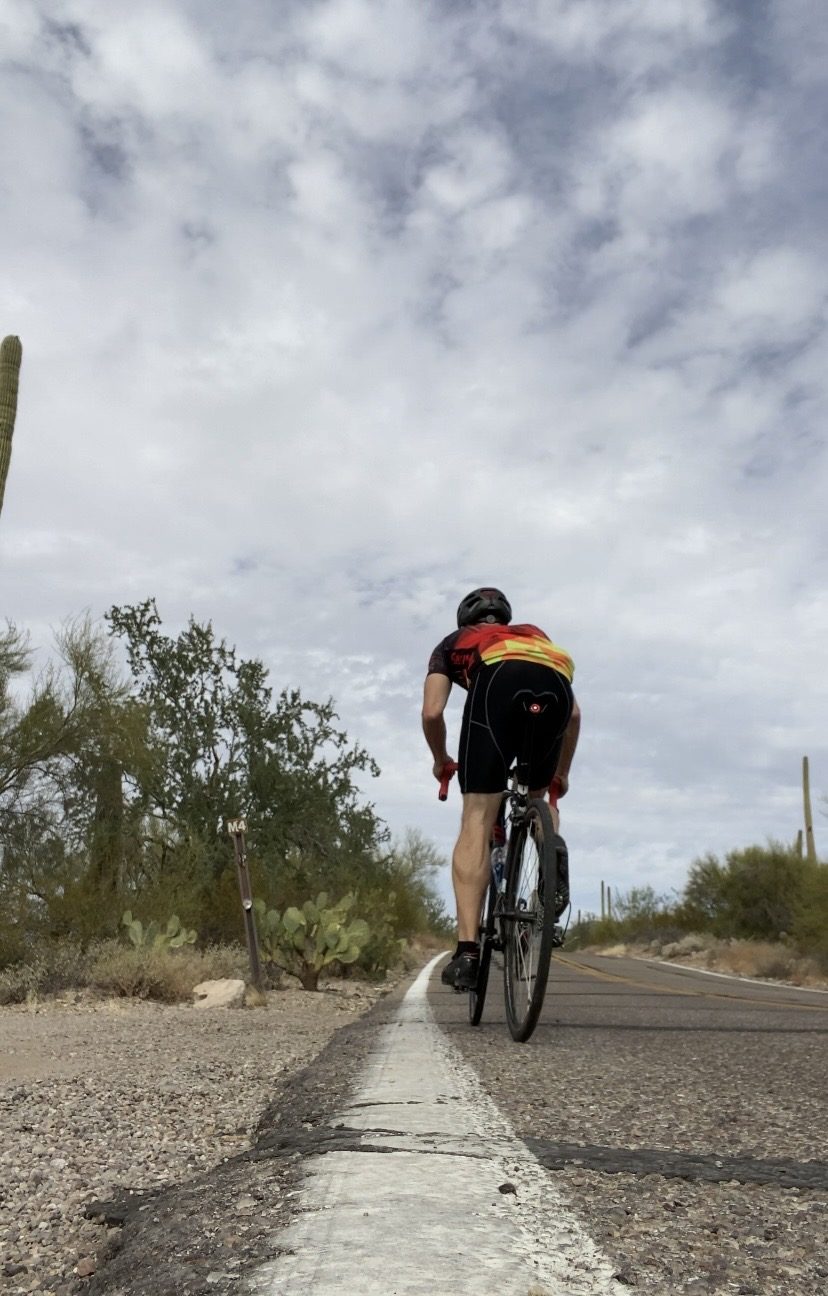
"How much should I drink?" comes right after "how many gels?" The honest answer is that it depends on you. Sweat rates vary a lot from person to person: one big review found most athletes sweat about 0.5 to 2.0 litres per hour, and some go past 3 litres in extreme heat [1]. The ACSM, AND and Dietitians of Canada statement gives an even wider range of 0.3 to 2.4 litres per hour [2]. So a one-size number won't fit. The good news: you can measure your own with a bathroom scale and one hour of training.
How to do the test
- Pee first, then weigh yourself nude. Write it down. Weighing twice and averaging helps [3].
- Ride or run for about 1 hour at race effort, in weather like your event. Precision Fuel & Hydration suggests 60 to 90 minutes: shorter tests magnify small scale errors [3].
- Track what you drink. Weigh or measure your bottles before and after.
- Try not to pee during the test. If you do, take off about 0.3 L (10 oz) per stop, a rule of thumb from Precision Fuel & Hydration [3].
- Towel dry and weigh nude again right after. Clothes hold sweat, so nude is most accurate [3].
Weight lost in an hour like this is mostly water: 1 kg is about 1 litre [3]. That's why the ACSM says you can estimate sweat rate from your weight before and after exercise [4], and the big review says to correct it for what you drank and any pee [1].
The formula
Example with made-up numbers: 160.0 lb before, 158.0 lb after, drank one 16 oz bottle, no pee stop. That's 2 lb × 15.3 = about 31 oz, plus 16 oz = about 47 oz per hour, or about 1.4 L/h.
Turn it into a drinking range
Here's the key point: don't try to drink back 100% of your sweat. Precision Fuel & Hydration says chasing full replacement raises the risk of hyponatremia [3]. The sources give slightly different guardrails:
- Top of your range: about 80% of your sweat rate. A German Society of Sports Medicine position stand says to drink "a maximum of 80% of the determined sweat loss" on longer efforts [5].
- Bottom of your range: enough to keep weight loss under about 2%. The ACSM's goal is to prevent more than 2% body weight loss from water deficit [4]. Others say a bit more is fine: the hyponatremia consensus says losses up to about 3% are tolerated in cool to mild weather [6], and the German stand and Precision Fuel & Hydration say 2 to 4% [5][3]. So the sources disagree a little. 2% is the cautious end.
- No sweat test yet? The ACSM, AND and Dietitians of Canada statement says most athletes do well on 0.4 to 0.8 L per hour, adjusted to the person [2].
Using the example above (about 1.4 L/h, 160 lb) for a 3-hour ride: 80% of 1.4 is about 1.1 L/h. Staying under 2% means losing no more than 3.2 lb (about 1.45 L) over 3 hours, so you'd drink at least about 0.9 L/h. A starting range of roughly 0.9 to 1.1 L (30 to 37 oz) per hour. Then let thirst fine-tune it on the day [6].
And salt? General sodium guidance
Sweat carries sodium, and how salty it is varies a lot. Precision Fuel & Hydration's sweat test data runs from about 200 to over 2,300 mg of sodium per litre of sweat, with an average near 950 mg/L [7]. The big review puts it at about 10 to 90 mmol/L, which is roughly 230 to 2,070 mg/L [1]. The ACSM, AND and Dietitians of Canada statement gives 230 to 1,610 mg/L [2]. Different studies, different methods, so the ranges differ.
Sodium per hour lost = sweat rate (L/h) × sodium in your sweat (mg/L) [7]. When does it matter?
- The ACSM, AND and Dietitians of Canada statement flags athletes who sweat over 1.2 L/h, have salty sweat, or go longer than 2 hours [2].
- For a shorter, cooler effort, Precision Fuel & Hydration says salting your normal food and drinking to thirst is usually enough [7].
- Signs you may be a salty sweater: white salt marks on your kit, sweat that stings your eyes, and craving salty food [7].
- Sports drinks usually hold about 10 to 38 mmol/L of sodium (roughly 230 to 870 mg/L) [6]. The German stand suggests 500 to 700 mg/L in drinks when sodium is needed [5].
Like fluid, you don't need to replace every milligram [7]. The gel calculator below suggests a starting sodium range by matching your drink's strength to how salty you sweat, the approach Precision Fuel & Hydration uses [7].
Put your number to work
The free Gel Calculator now has an optional Water and sodium step. Enter your before and after weights, what you drank and how long you went, or pick "I don't know it." It shows your sweat rate, a fluid range and a sodium range right next to your carb and gel plan.
What you need
A body scale that reads to 0.1 lb or 0.1 kg helps, since you're measuring small changes. A bottle with ounce or ml marks makes tracking easy.
Body scales on AmazonMarked water bottles on Amazon
Sources
- Baker LB. Sweating rate and sweat sodium concentration in athletes: a review of methodology and intra/interindividual variability. Sports Med 2017;47(Suppl 1):111–128. pmc.ncbi.nlm.nih.gov/articles/PMC5371639
- Thomas DT, Erdman KA, Burke LM. Nutrition and Athletic Performance (ACSM / AND / DC joint position statement). Med Sci Sports Exerc 2016;48(3):543–568. doi.org/10.1249/MSS.0000000000000852. Fluid and sodium figures as summarized in Today's Dietitian.
- Blow A. How to measure your sweat rate. Precision Fuel & Hydration. precisionhydration.com
- American College of Sports Medicine; Sawka MN, et al. Exercise and fluid replacement (position stand). Med Sci Sports Exerc 2007;39(2):377–390. pubmed.ncbi.nlm.nih.gov/17277604
- Mosler S, et al. Position stand: fluid replacement in sports. Dtsch Z Sportmed 2020;71:181–186. doi.org/10.5960/dzsm.2020.453
- Hew-Butler T, et al. Statement of the Third International Exercise-Associated Hyponatremia Consensus Development Conference, Carlsbad, California, 2015. Clin J Sport Med 2015;25(4):303–320. cupola.gettysburg.edu/healthfac/66
- Blow A. How to estimate how much sodium you lose in your sweat. Precision Fuel & Hydration. precisionhydration.com
Got a question you want me to cover next? Find me on YouTube, or visit travlnbike.com for more.
Ride safe,
Paul